For medical directors, care coordinators and clinical operations leaders tracking the gap between planned care and recorded follow-through. A missed pickup may begin with a transportation problem. An unanswered reminder may need a different point of contact.
From the CareChain demo
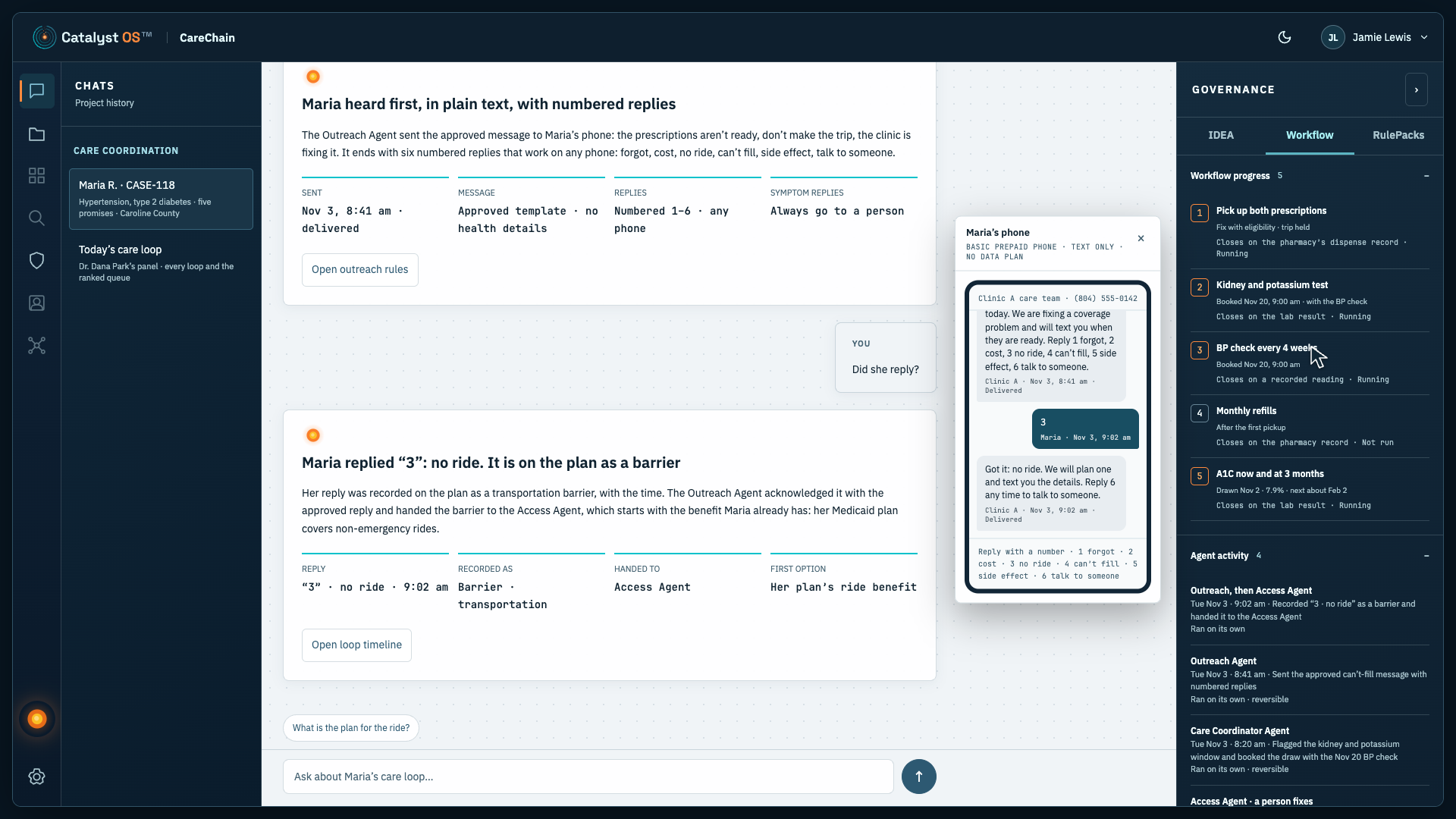
“No ride” becomes a next step.
Maria’s reply puts transportation on the care plan as a barrier. The next step is to check her plan’s ride benefit and coordinate follow-up.
Fictional scenario from the walkthrough. A patient reply adds context; the care team retains clinical decisions.Care coordination
CareChain care-plan follow-through
CareChain focuses on the work between a care plan and its follow-through: medication events, patient replies, barriers and the questions a coordinator needs to resolve.
For
Clinical operations, medical directors and care coordination teams.
Focus
Medication pickup, care-plan follow-through, patient barriers and staff escalation.
Evaluate
Your care setting, coordinator workload, clinical review responsibilities and connection to existing records.
In this ten-minute walkthrough, meet Maria and follow her care team through medication access, transportation and clinical review. Watch who takes responsibility, where a person makes the decision and how follow-through is confirmed.
Demonstration using fictional people, records and scenarios. English captions available.
Trace the payment difference. Give reviewers the context.
A separate module for healthcare finance and revenue-cycle teams investigating billed, remitted and expected payments.
Healthcare finance
Payment and claims review
Payment and claims review centers on the relationship between a billed service, the expected payment, the remittance and the exception a reviewer needs to investigate.
For
Healthcare CFOs, revenue-cycle leaders and billing operations.
Focus
Payment attribution, remittance matching and evidence for exception review.
Evaluate
Source formats, payer-contract context, exception categories and reviewer handoffs.
Illustrative payment scenario · Fictional amounts
A difference worth investigating.
Billed charge$200
Service charge
Expected payment$150
Example contract assumption
Remittance paid$120
Amount on the remittance
$30 to investigate
What explains the difference from the expected payment? Review adjustments, patient responsibility and contract terms before deciding on follow-up.
The $80 difference from billed charges is not automatically a denial or recoverable revenue. The example illustrates a reviewer’s question, not a collection outcome.
For a small clinic, following up can mean coordinating across a pharmacy, a family member and a ride to the next appointment. Our ambition for CareChain is to make that coordination manageable within the clinical team’s day.
Context for the next conversation.
A reading, a missed visit or a patient’s reply becomes more useful alongside the care plan. The goal is to help staff understand who needs attention and why, with consent guiding who can be involved.
Care and administration in view.
CareChain and claims reconciliation address different responsibilities on the same platform. The longer view connects documentation of delivered care with the records finance teams need to investigate payment, while preserving clinical judgment and billing review.
Fit with your organization
Choose a care or payment process. Define the improvement you need.
Care delivery
Identify your care setting, handoffs and unresolved follow-up. Assess coordinator time and outstanding patient needs.
Financial operations
Define the payment population, exception categories and investigation effort. Keep identified differences separate from collected cash.
IT and privacy
Discuss source systems, data access, consent, retention and support responsibilities with the people who own them.
Healthcare evaluation
Which workflow does your team own?
Start with care continuity or revenue-cycle review. Bring the systems involved, the handoffs that create friction and what a useful result would look like. Please do not send patient information.